The Intent Toll Booth
The retail media auction is gravitating towards the agent layer, where purchase intent now forms. But issuing banks have an ace up their sleeve. With the right bundle, they can earn a privileged seat in the flow of intent data, and finally live out their retail media network dreams.
Merchants spend 10-20% of revenue on top-of-funnel acquisition. They spend < 2% to accept card payments. All else equal, card issuing banks would much rather be in the retail media network business. It's a larger TAM, with higher margin, and lower balance sheet risk. See: Chase Media Solutions, Amex Ads, Revolut Media Solutions, Klarna's Ads Manager.
But these haven't historically been home runs. So what's different this time?
The prevailing view is that nothing is different, and that the auction is in fact moving further away from banks. As consumers express purchase intent inside ChatGPT, Gemini, and Claude, the most monetizable dataset forms at the agent layer. In that view, issuers end where they have always feared ending: as a funding credential at the bottom of someone else's funnel.
I think the consensus is wrong. The question that decides where agentic commerce economics concentrate is an unglamorous one: who eats the servicing costs and losses when the cardholder rings up and complains that the agent bought the “wrong” thing? The model providers don't have the balance sheet, the servicing operation, or the appetite to accept any form of liability. The card networks build trust and governance but similar to the model providers have never held the liability nor have the desire to. And merchants can't underwrite agent execution for consumer AI agents that they don't control. Meanwhile, issuers are perfectly positioned: they don't have a monopoly on providing insurance per se, but they do have a giant head start with the bundle of premium collection (interchange) + underwriting infrastructure + funding credential + dispute/servicing machine. They can parlay that into something immensely valuable: a contractual reason for every unit of purchase intent to route through their hands.
The Vision
The vision is agentic shopping embedded inside an issuer's banking app paired with real-time merchant bidding based on proprietary intent data. A money-center bank like JPMorgan Chase can bundle two things for cardholders that no other actor in the stack can: purchase protection and targeted offers. Let's break down both.
Purchase Protection for Agent Error
Notice the gap in today's regime: if a merchant ships the wrong jeans, Reg Z gives you dispute rights and a chargeback path. But if the merchant fulfills the order as your agent instructed, and you just disagree with how the merchant executed your intent, you're in for a real headache. You authorized the transaction, and no reason code covers "my agent misunderstood me." You may have the merchant's return policy, but what happens when returns simply fail: final-sale, travel, event tickets, custom/configured goods, perishables, anything time-bound.
This "intent mismatch" question has stymied stakeholders across the agentic commerce value chain but tech-forward banks with the balance sheet could square the circle. They can make purchase protection conditional on using "their" shopping agent (which of course, can be licensed and offered in partnership with Anthropic, Gemini, or OpenAI). The intent payload the issuing bank demands before authorizing a payment is the adjudication evidence for any future cardholder dispute. "Here's what you asked for, here's what the agent resolved it to, you confirmed the constraints." This protection wedge is no longer speculative; Amex's ACE Kit, announced in April, planted the flag on issuer-in-the-loop. Amex's Agent Purchase Protection, critically only applies where the card member has registered their AI shopping agent with Amex and Amex has authenticated purchase intent.
Hyper-Targeted Merchant Offers, In-App
The average consumer today, despite using ChatGPT for discovery, isn't going out of their way to use AI agents for commerce just yet because they're not getting an experience that's materially better, faster, or cheaper. But a hypothetical JPMorgan Chase shopping agent built in partnership with OpenAI would know a cardholder's stated purchase intent alongside their transaction and return history, buying preferences, lifestyle searches, and credit line/account balance. Meanwhile, merchants of course know their real-time inventory and margin. If the two parties can negotiate in real time, then you get dynamic personalization for the consumer that's actually personal instead of the blunt promo codes that online commerce has settled for to date. This type of hyper-targeting is even more valuable for high-consideration purchases like luxury goods, travel and auto, and large electronics.
The rudimentary version of this, card-linked offers, failed on two fronts: the data was backward-looking, and the offers lived four taps deep inside a banking app nobody really had a good reason to open for shopping. This new model fixes the data problem with upstream, pre-purchase intent and fixes the distribution problem via hyper-targeting, which makes the offers compelling. This is something that the top five issuing banks would build and offer themselves leveraging proprietary data and distribution deals…and for that reason would also be something they actually invest in (they're fairly allergic to socialized goods).
How the Intent Actually Flows
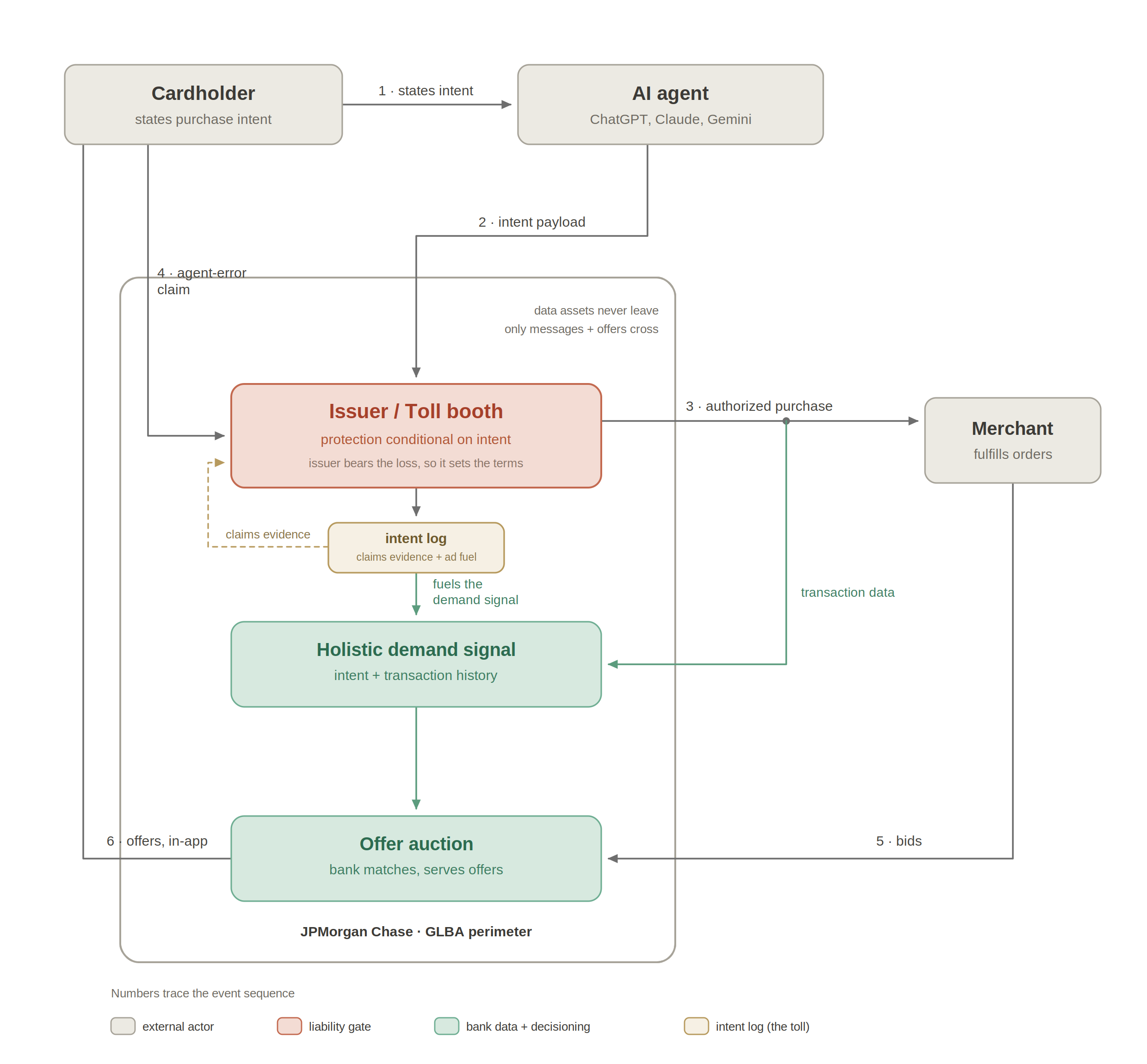
None of this requires the consumer to initiate shopping from inside the Chase app. Picture a Chase Connector inside ChatGPT or Claude: the consumer expresses intent wherever they already are, and Chase steps in to validate, match, and stamp that stated intent against the product the agent is about to buy — because the issuer is the one taking liability for the purchase.
The mechanics are crucial. Protection conditional on intent means the issuer must receive the intent payload before it authorizes: what was asked for, what the agent resolved it to, at what price, with what constraints. Drew Edmond points out that, “Network-led initiatives like Mastercard Verifiable Intent do verify constraint credentials during authorization, but only the hard bounds (amount, identity, MCC); not the soft bounds that would still require issuer adjudication in the event of a dispute e.g., any natural language components that introduce a non-deterministic decision”. Satisfaction is non-deterministic; two reasonable parties can disagree about whether the purchase honored the intent.
So the issuer's purchase protection stamp becomes a toll booth, and the intent log is the toll. Chase doesn't need to win the interface war against OpenAI; it just needs the agent to submit intent in order to get the purchase protection.
Then, back in the banking app, the consumer gets a continued omnichannel experience: offers based on what they were shopping for inside ChatGPT yesterday. It's effectively retargeting, but built on intent the issuer received as a condition of underwriting rather than scraped from a pixel.
To be clear: The toll booth mechanism laid out here rests on the core premise that the intent payload will be met with proprietary decisioning when it passes through the issuing bank during payment authorization. The Networks and Model Providers of course are trying to figure out how to make that very artifact – signed/stamped intent – a standardized field through efforts like Visa Intelligent Commerce, Mastercard Agent Pay, etc. Networks don't take on liability but aim to allocate liability by rule constantly: EMV liability shift, 3DS liability shift, etc.
As Frank Young notes: “If stamped intent becomes a network-level standard the way 3DS data did, every issuer receives the decisioning by default and the issuer's toll booth becomes a shared utility.” In fact, the entire history of modern payments is the serial construction and circumvention of toll booths. See: Least Cost Routing and Network Tokenization, Paze.
But as long as the issuer – as the party that's accountable for funds transfer – is the one being asked to eat the cardholder servicing costs and losses, they're going to insist on owning the decision that produces the intent stamp. A green check mark handed down from someone upstream doesn't transfer the loss, so it won't substitute.
The Regulatory Moat
Under the Gramm-Leach-Bliley Act (GLBA) and Regulation P, banks face strict rules against sharing nonpublic personal information with unaffiliated third parties. However, there's a difference between sharing data and leveraging it internally. When Chase surfaces a targeted offer to a cardholder inside their own mobile app, they are processing it in-house. So there's no data “sharing”. The merchant provides the budget and the criteria, and the consumer sees the offer. No raw PII or financial data ever leaves the bank's perimeter. It's only when Chase pushes audience segments outward to OpenAI, that it falls back in Reg P territory. Structuring that partnership correctly is half the legal work, and it's also a quiet advantage for the banks: they've spent decades building exactly this kind of vendor-management machinery.
So mega-banks get to bypass some of the privacy roadblocks that hamstrung Big Tech's ad networks post-iOS 14 IDFA changes.
Ecosystem Buy-In
None of this works of course unless other critical constituents in the value chain are bought into the model. Frontier labs, and merchants in particular. Let's tackle each in turn.
Model Providers
"Why would someone like OpenAI not cut out JPMorgan Chase and aim to monetize the intent data by running ad auctions themselves?" In a vacuum, of course that would be their preference. But agentic commerce adoption is still anemic today, which means that the first step is simply doing whatever you can to grow the ecosystem and change consumer behavior. Alex Johnson makes an analogy to PayPal here from the early days of e-commerce: “The thing that always holds a new modality back from success is liability and consumer fear. You always need someone else to solve that piece before the growth really gets unlocked. PayPal solved safe online commerce for eBay before eBay really took off and acquired them.”
The bundle that money-center banks can provide is one potent route to change consumer behavior — purchase protection over the agent's actions, dynamic merchant offers, dispute and customer servicing at scale, and a regulatory perimeter that took a century to build. This is what has the potential to pull the consumer's intent-expression behavior into the system in the first place. So for OpenAI, a smaller share of a much larger pie is a better deal than trying to go it alone, and that's what a partnership with JPMorgan Chase gets them. The model providers are increasingly wanting to be the all-purpose AI agent providers for their customers anyway…you're going to see a lot more distribution deals with Claude, Gemini, and ChatGPT embedded inside your most frequently used consumer apps.
Merchants
What about merchants, why would they buy into this system? Merchants are rightfully skeptical of giving up data (power) to issuing banks because of structurally opposing incentives in the card network ecosystem. But the merchant isn't actually surrendering anything here. What they're buying is access to a demand signal they couldn't generate themselves — pre-purchase intent from verified cardholders who are actively in-market to buy. That's similar to how Google Search monetizes intent today. And to be precise about what's being sold: merchants bring budget and targeting criteria; Chase runs the query against its own dataset and serves offers to its customers. The merchant is a bidder in an auction for high-quality demand, full stop.
One caveat belongs here: over enough auction cycles, a merchant's bidding behavior reveals its margin structure and inventory posture to the bank. Nothing is handed over explicitly, but plenty is leaked. Merchants will price this in eventually; the smart ones from day one. Merchant resistance to issuer-led models is also political, not just economic. A world where Chase mediates demand allocation means merchants who don't bid lose share to those who do. That's pay-to-play and the NRF will scream about it from time to time, but such is life.
The idea is that JPMorgan Chase now has something no issuer has had before: the combination of actualized purchasing behavior with top of funnel intent data. Payment transaction data on its own is downstream and lossy (merchants almost never send Level 2/Level 3 data over standard card rails). Intent data alone is still speculative. Combined, that's one of the highest-value demand signals in commerce; something that merchants would pay top dollar for. JPMorgan Chase can now tell a CMO that, "John has bought jeans from Madewell three times in the last two months, returned one of them, and has a $9k average monthly spend skewing toward premium apparel." That type of dataset is something every CMO can monetize. And Chase can provide that conversion history on 80M+ cardholders at scale across all merchants.
Now, large omnichannel retailers like Nike and Target already have substantial first-party data on their own customers. They have loyalty programs, accounts and purchase histories, return rates, and more for their existing customer base. But Chase's data is still transformative for Nike because while Nike only knows what a customer buys at Nike, they are fairly blind to what that same customer is spending at Adidas, Lululemon, or Equinox. Chase has the power to see the consumer's entire wallet share, cross-merchant.
Card Networks and Mobile Wallets
An individual issuer only sees their own cardholder and transaction data while Visa and Mastercard sit across every issuer and merchant interaction. So hypothetically the networks could have built an even more powerful data advantage here. However, networks don't interface with consumers directly, nor do they price and own risk; they designed the system to push liability out towards the edges. That's why they don't sit in the hotpath for intent, despite their active efforts. The various network frameworks being designed address authentication, tokenization, KYA, and more, but they do not address the central question of liability for an agent's actions.
Apple Pay and Google Pay sit in the checkout hotpath, have device-level distribution, and arguably see intent formation too. But similar to the networks here, they have no true balance sheet appetite (see the Goldman/Apple Card unwind), no servicing operation.
The Toll Booth Isn't Only for the Top Five
So far this is a story about money-center banks. But the top five issuers aren't the only ones facing the agentic-commerce wave. Thousands of issuers, program managers, and fintechs face the same wave with none of the machinery to fight. That machinery, which makes the toll booth work, is essentially a set of issuer processing primitives:
- Intent-payload ingestion and validation at the moment of authorization to match up against a specific card program's proprietary risk and governance logic
- Evidence that packages the intent log for cardholder support, dispute management, and chargeback processing
- Agent-scoped funding credentials with merchant, amount, velocity, device, and even line-item constraints.
Modern issuer processors will increasingly become the programmable governance layer for intent-conditioned authorization and cardholder servicing.
Banks Want to Be Retail Media Networks Again
The economic gravity is reorganizing in real time around the point where buying intent is mediated. That creates an opportunity for issuing banks. Issuers that close this loop using intent data, purchase protection, and context-aware dynamic discounting, will have successfully built retail media lines of business. It's a big vision but I don't think it's farfetched. The pool they'd be tapping — merchants' customer acquisition budgets — is multiples of total US interchange, so they'd be crazy not to try.
Chase Media Solutions will probably announce an agentic shopping layer within 18 months, unless Amex Ads or Capital One Ad Solutions ups the bar and does it sooner (being both the issuer and the network provides another leg up in this race). These banks don't build hundreds of billions in market cap without having some brilliant people cooking things up. It's an aggressive prediction but it's falsifiable, and I'd rather be interestingly wrong than equivocate.
Thank you to Frank Young, Alex Johnson, Aditya Goel, and Drew Edmond for their invaluable thoughts and feedback on this essay.